Five Degrees to Mexico with 59 North
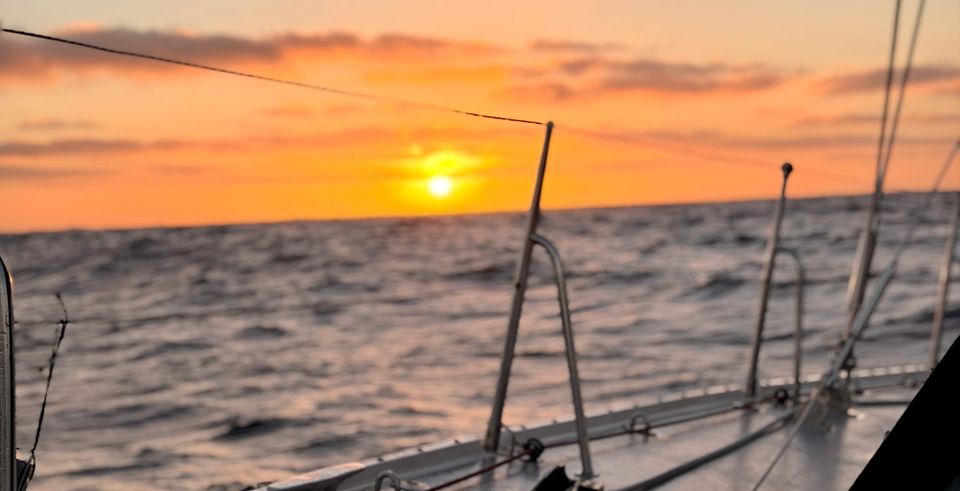
Note: Although most entries on this project are slowly catching up from the past, this post is contemporaneous, with these events happening in early November, 2026.
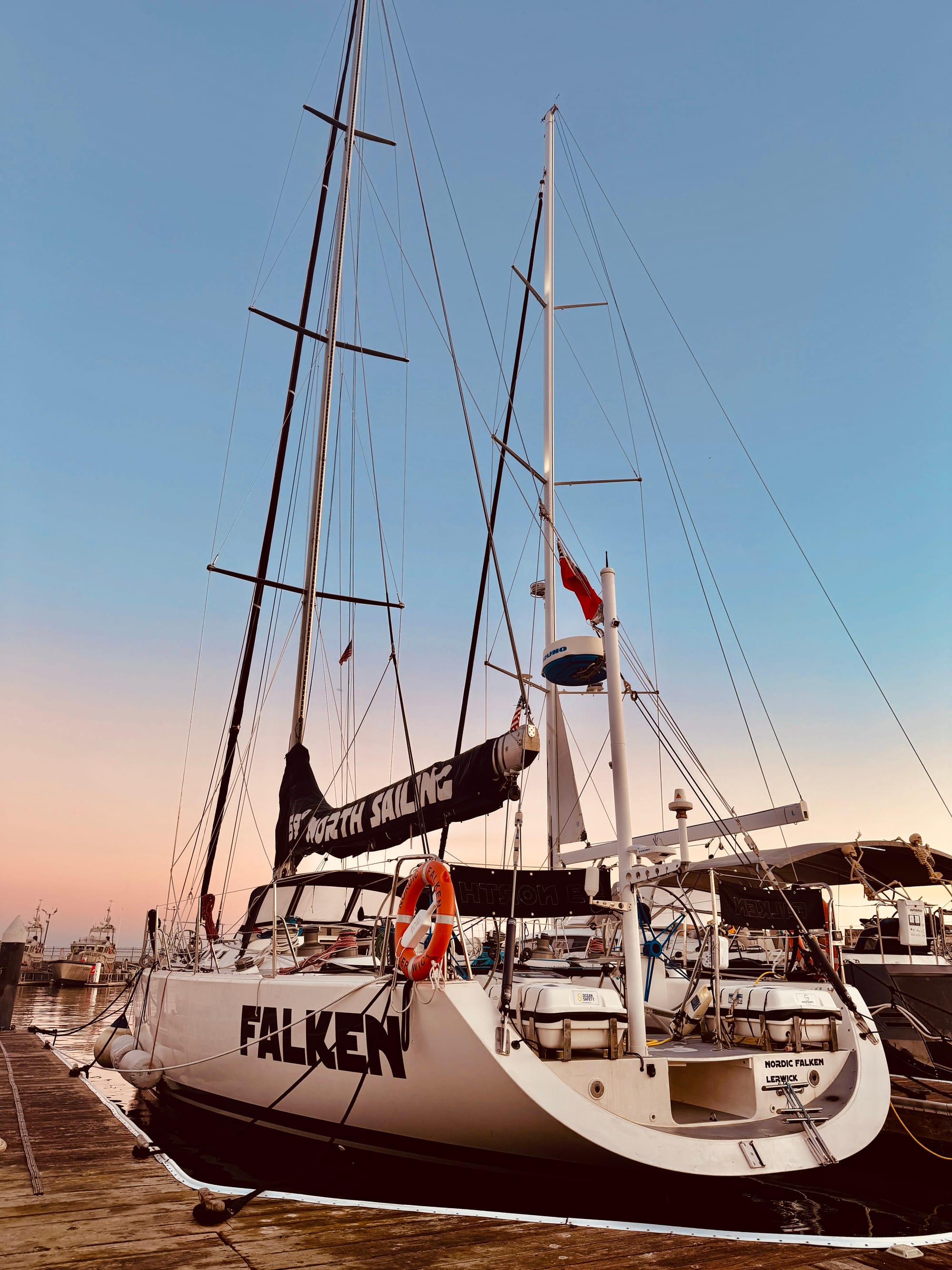
For the first 16 hours of our sailing passage with 59 north, my abilities were limited. I was able to take the helm and steer the boat. I could sit up top in the enormous open cockpit of the 65-foot Nordic Falken and watch 13-foot waves stack beyond the stern and feel the sails absorb gusts into the thirties as darkness overtook us. I could make entries—barely—in the log book. Finally, I could wedge into my bunk for fitful bouts of quasi-hallucinatory half-sleep. But, say, brushing my teeth? Not a chance. Scribbling a journal entry? It wasn't happening. Washing up or changing my socks? Nearly unimaginable.
The unending movement of the boat was the fly in the ointment of these basic tasks. When you sign up to do an ocean passage with 59 North, the company will warn you that even very experienced coastal sailors are likely to be surprised by just how much the boat is always moving at sea. Personally, I only have a couple thousand miles of coastal sailing in my log, still a newbie in my junior sailor togs. And, although we’ve poked the nose of our boat far enough out into the Pacific to get a sense of the immense power of unchecked ocean swell, this is something new. Down below, in the hull, it feels not unlike how I imagine it might be to reenter the atmosphere from space.
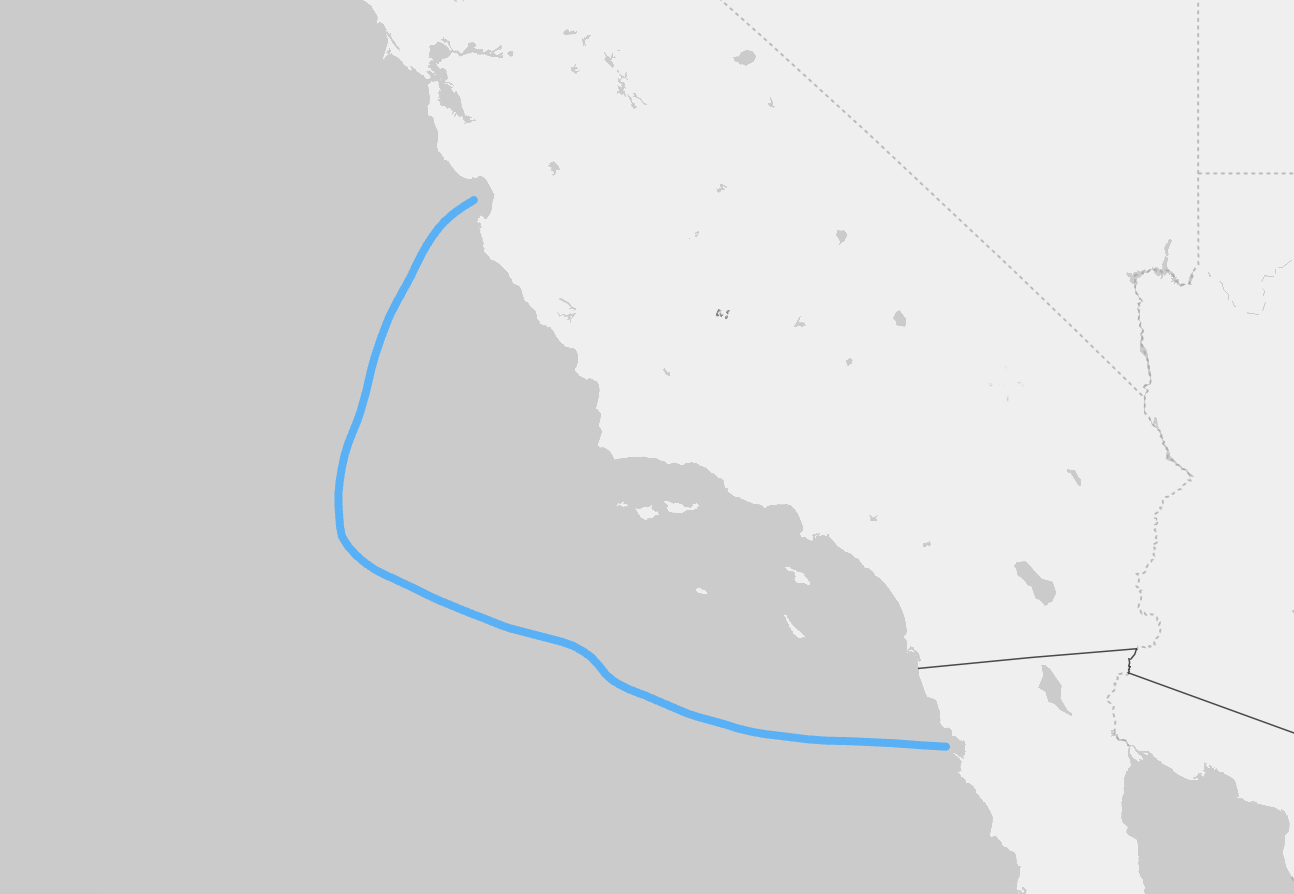
The weather and sea conditions dictated this kinetic initiation to our passage. We had left Monterey Bay in California, bound for Ensenada, Mexico, gliding over sizable, rolling swell and then turned more south into building waves being pushed down the coastline by a gargantuan low pressure system in the North Pacific. This year’s strong El Niño was, indeed, doing El Niño things and the effects were increasingly being felt in the open ocean and along the shoreline of the Americas. Rather than gradually building toward bigger seas and winds, we sailed early into peak passage conditions, with a forecast suggesting an eventual diminuendo as the days progressed and we made roughly 5 degrees latitude to the south.
For me, the start was equal parts alarming and exhilarating. Alarming because, can I do this? I mean long-term? We have a goal of ocean passages on our own boat and this, well, this felt like a lot. At the same time it was exhilarating because Falken is a big, fast boat, and we were in conditions she was built to thrive in. Despite the sense of movement and sound below, the boat was in a balanced groove. After a shared meal up top and watching the sun set over the sea as land disappeared behind us, I headed to my bunk to rest/resonate-against-the-hull before my first watch.
When I climbed up the companionway at 8 pm, I entered a different world. The team moving off watch were hooting about the speeds they’d seen surfing down waves. Conditions were just as big—if not more-so—but the clear, moonless night was a torrent of stars rotating around us. The sea, a mass of undulate thunder, was rippling with car-sized patches of phytoplankton which, when agitated by the waves, erupted in wild, blue bioluminescence. At one point during my shift at the helm, the skipper needed to go below, leaving me entirely alone at the wheel. For several minutes, while I kept my bearing based on a star above the bow and just to windward of the headsail, I steered through outer space, shooting stars blistering past, all sense of light from land left behind, and enormous glowing orbs floating all around me. All with my sliver of a corporeal body shifting gently in time with the sea amidst this cosmic immensity. It is as indescribable an experience as I’ve ever had.
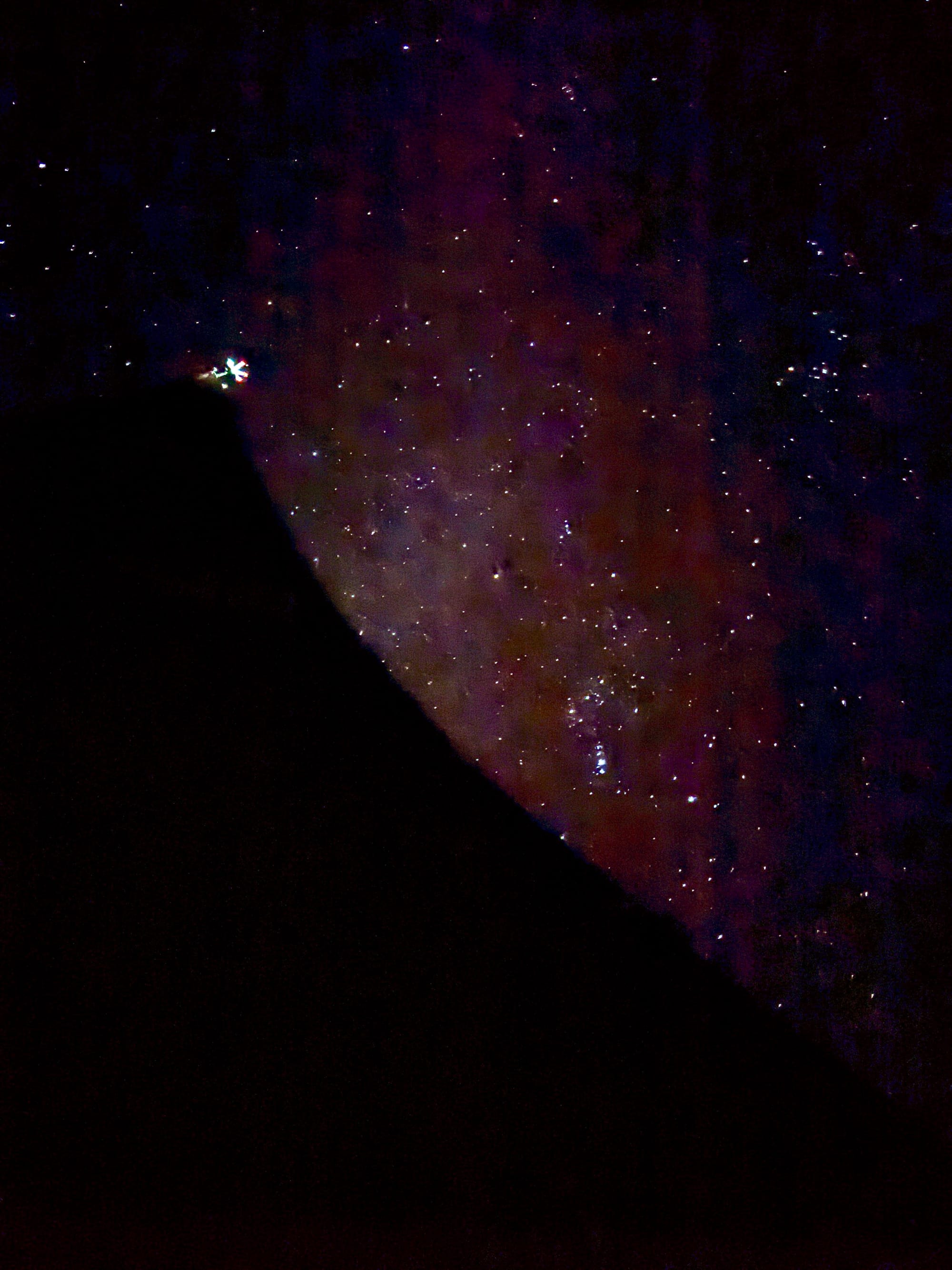
Part of me wishes I’d had the equipment and skill to capture quality images or video of this night, but another, wiser part of me knows it’s much better that all I could really do was embrace it for myself.
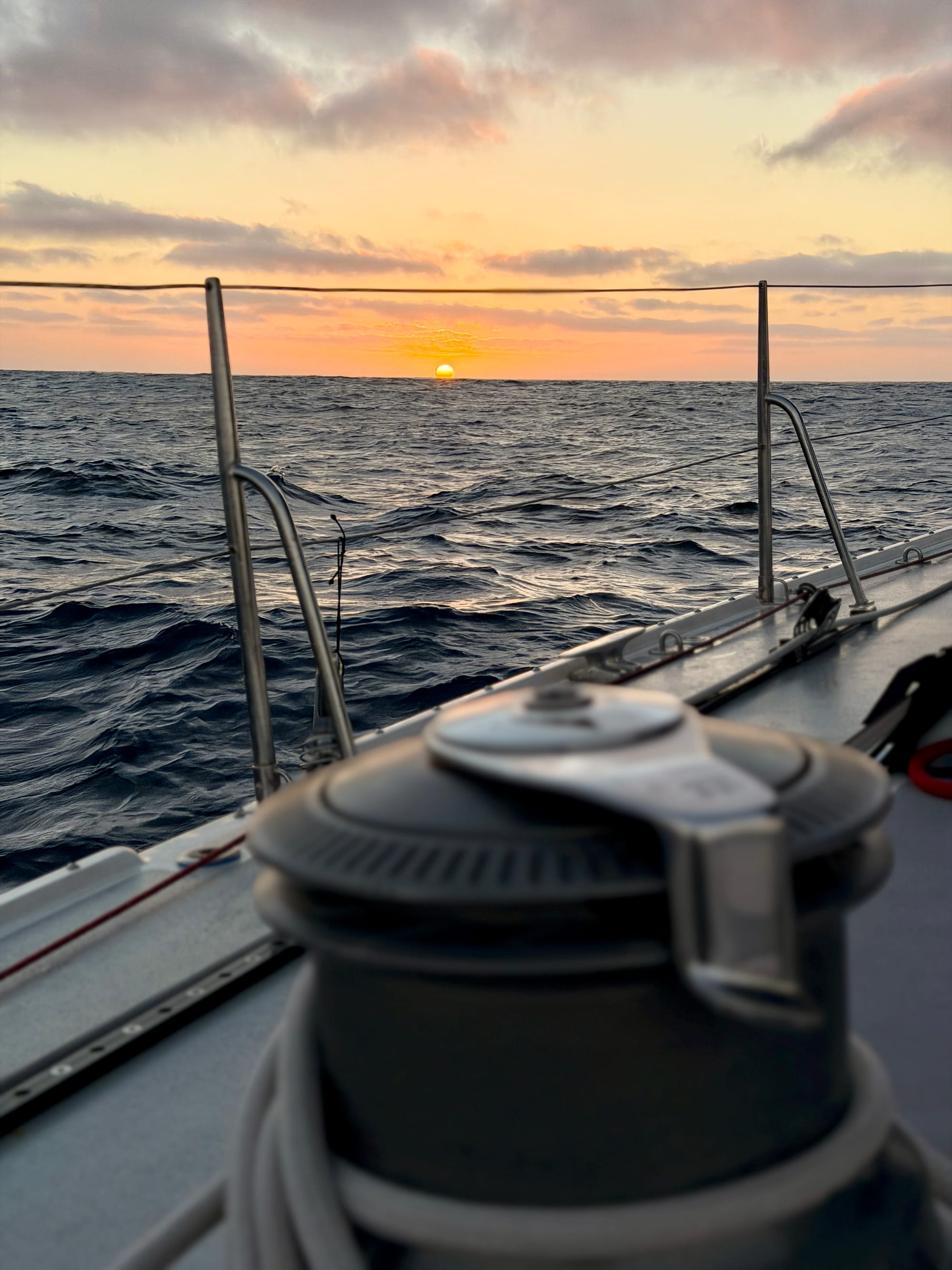
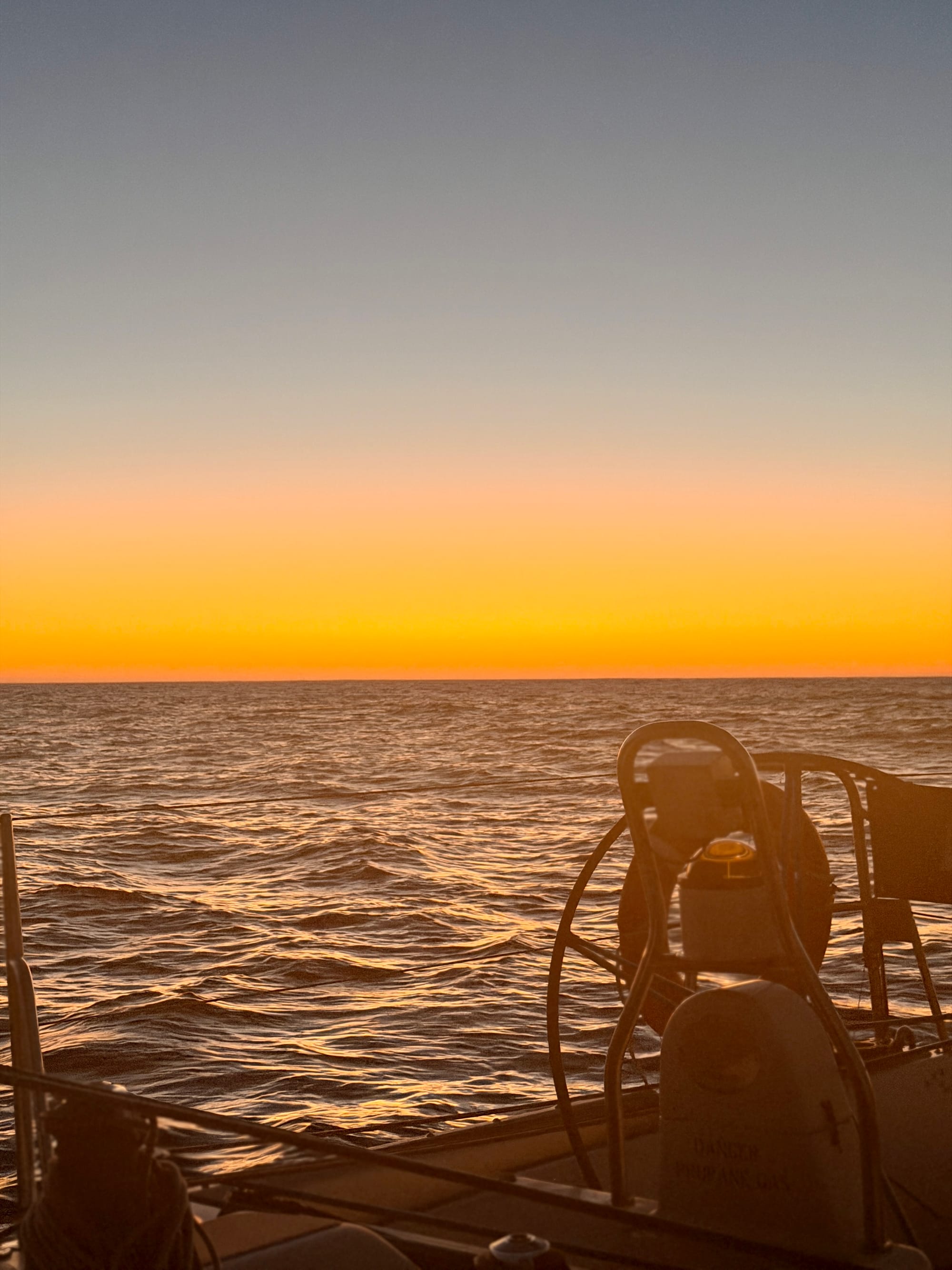
My next shift began at 5 am. The dawn watch. And another quietly unforgettable experience. At this rate, developing Stendahl's Syndrome seemed a real risk. Fortunately, although I’d only slept fitfully, I was acclimating to the conditions, becoming more inured to the movement. I got those teeth brushed. I changed those socks. I began to settle into the rhythm of the passage. A favorable watch schedule allowed me to be on watch again as we sailed toward dusk that evening. To both greet and release the sun, under sail and out of sight from land, was an experience I had been internally, almost subconsciously anticipating for nearly two years. A thing I had been reluctant to name for fear it would vanish from the possible.
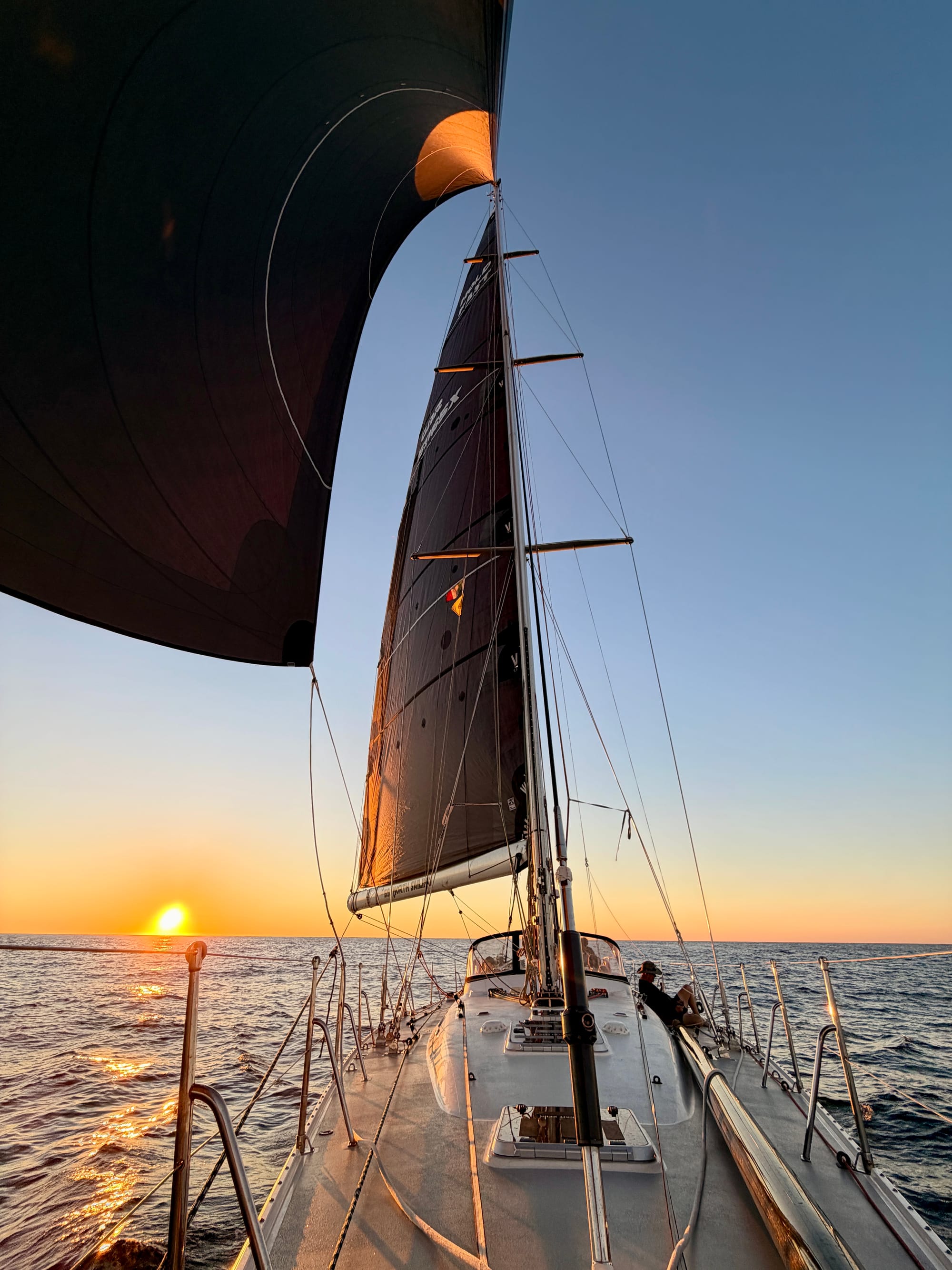
Katherine and I were on watches together. Not a given. As a couple, you don’t want to be too insular or cliquish or cut yourself off from things you might learn from the rest of the crew. On the other hand, we’re pretty diligently working toward something here and part of that involves gelling as a team on a boat and a lot of comparing notes and observations. For us, it was the right choice. Contrary to what might be expected, our most challenging watches and helming experiences were in light winds. We had the opportunity to helm with both the spinnaker and sailing “wing-on-wing”, ie, with the headsail held out by a pole and the mainsail eased open, a strong line attached to prevent a crash gybe from causing damage or injury. In steady wind, both situations should present easy steering, but in light winds and a sea state persisting at 8 feet or so, I found it more challenging than expected. The interval between waves was long and forgiving, but when a wave did come, we would lift enough to increase speed beyond the blow filling the sails and time would stop while the cloth danced back toward the mast in a teasing gyration, before shooting forward with a resonant “ttthhhwump!”
Spinnaker edit courtesy of Katherine Lee
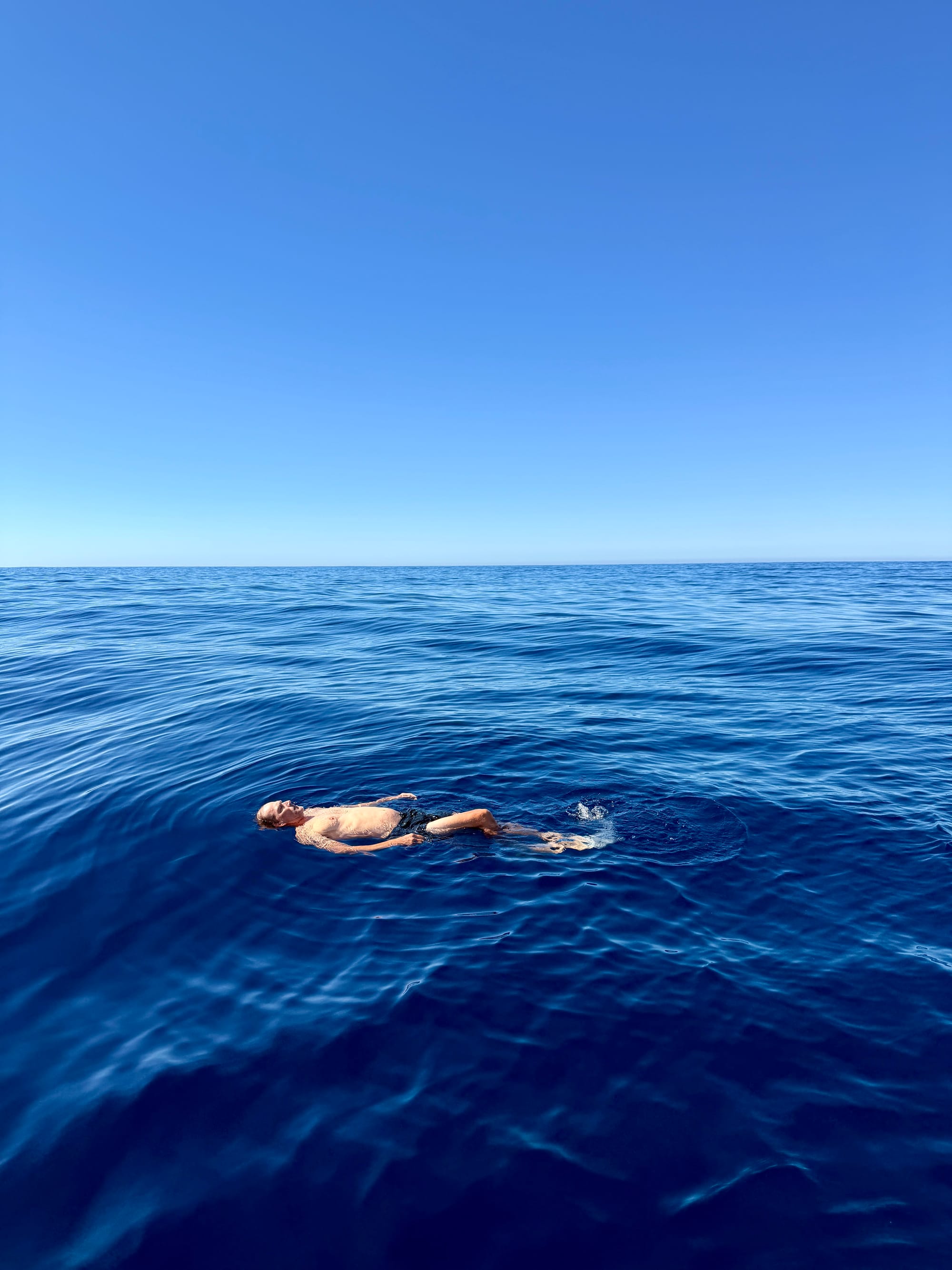
The wind gives and the wind takes. And when the wind had taken nearly all of itself, we were becalmed in the bright sun, bobbing atop 3600 feet of depth. Time to go for a swim. With the helm tied off, and a long floating line and buoy cast behind the boat, we stripped to our smalls and leapt into the sea, nothing but birds in sight in any direction.
It was magnificent.
Even in relatively calm water, the unceasing swell is a potent force to be swaddled and tossed by. Just to drift through the sense of being enclosed in rolling waves and then be suddenly elevated upward until all I could focus upon was horizon…I can hope to find these moments again, but I’ll never forget these first encounters. To dip my head under, open my eyes to a salty sting and stare down as intently as possible, was to encounter an electric, throbbing blue that felt very nearly sentient. It was as though some deep middle of the ocean—below the bright upper strata and above the solemn dark far beneath—was staring back at me and waiting for my question. Being unprepared to ask, I could only surface and float anew.
An evening of light wind and slow progress was a test, but a welcome one. This is why we are here, to find and understand as many variables as we can, with the benefits of adult supervision and well-prepared meals. But in such conditions, the slatting of the sails resonates through the boat and, when helming, you feel responsible for every sound transmitted to the crew in bunks below. Later, when I woke to prepare for our 2 am graveyard shift, the sounds and sensations had changed. Just laying in the bunk, I could feel we were on a reach. The motion was purposeful, the roiling sea against the boat, maybe two inches from my head, the entire ocean just on the other side of a kevlar-reinforced fiberglass hull, sounded less like the chaos I’d heard on the first night, and more like Falken was a hungry, panting beast, on the hunt for a preferred terrain and pace. Knowing these conditions would greet me, rather than the tender meandering, I have to admit to whispering to myself: Thank fuck.
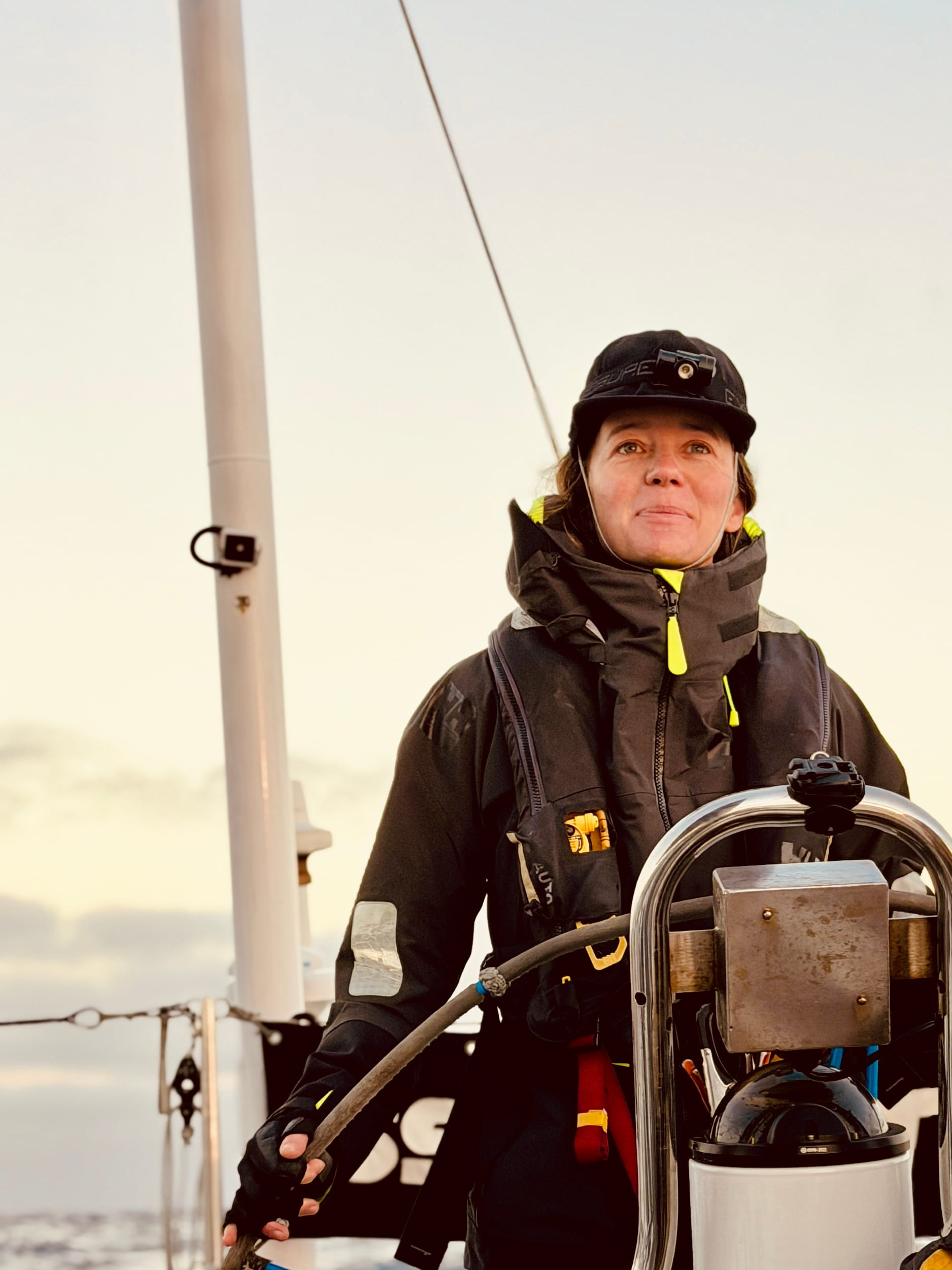
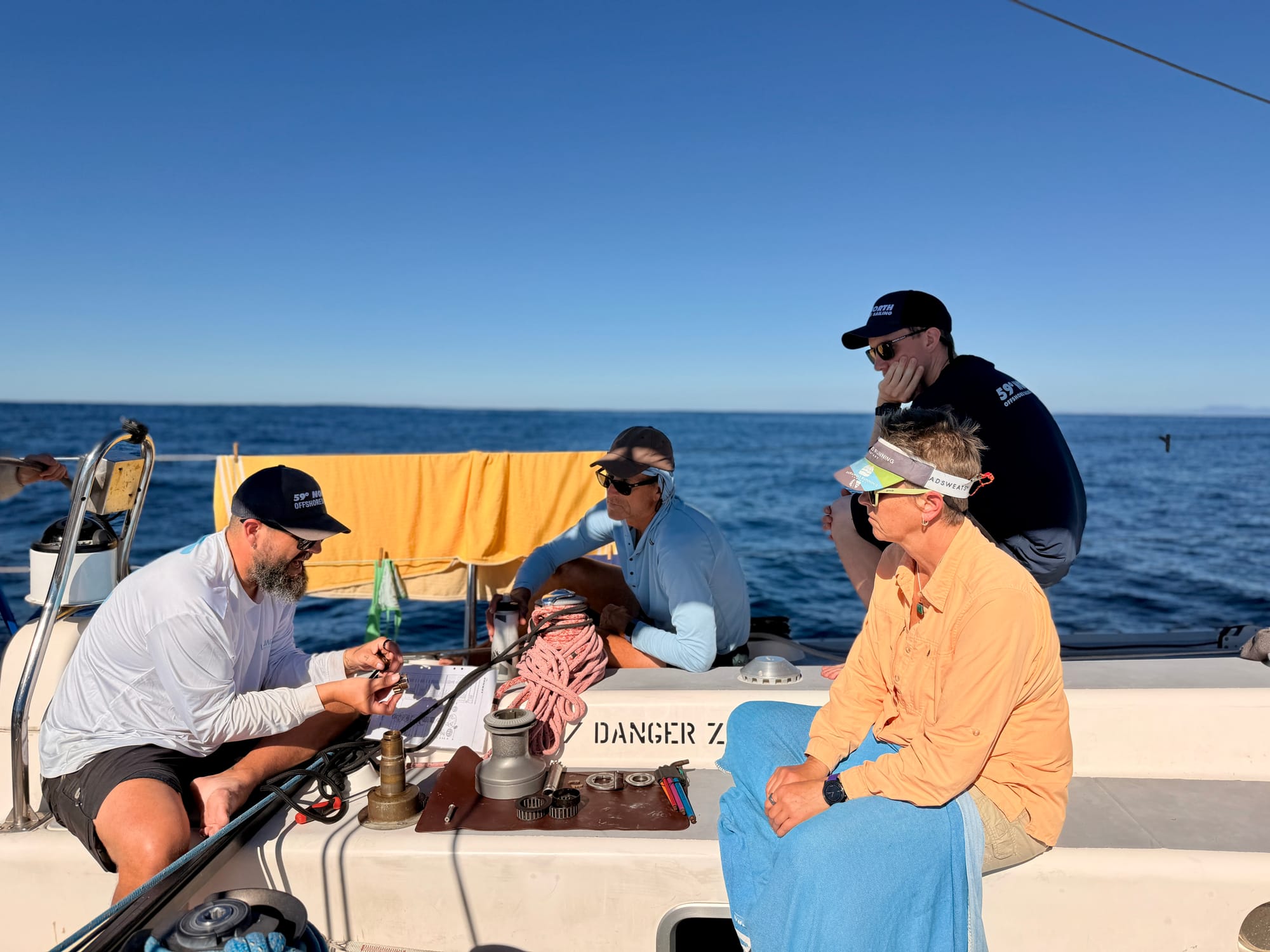
We were gifted another star-filled extravaganza of brisk sailing, barreling now toward the coast of Northern Baja, already having shifted to a bearing on Bahia Todos Santos, where Ensenada lay in wait. Not everyone had it so lucky as daylight brought a return of the flukey winds created in the shadow of Southern California. We were forced to motor for a few hours, but filled the time with skipper Alex Laline offering tips on sextant handling and celestial navigation, while mate Adam Browne demonstrated winch maintenance tips.
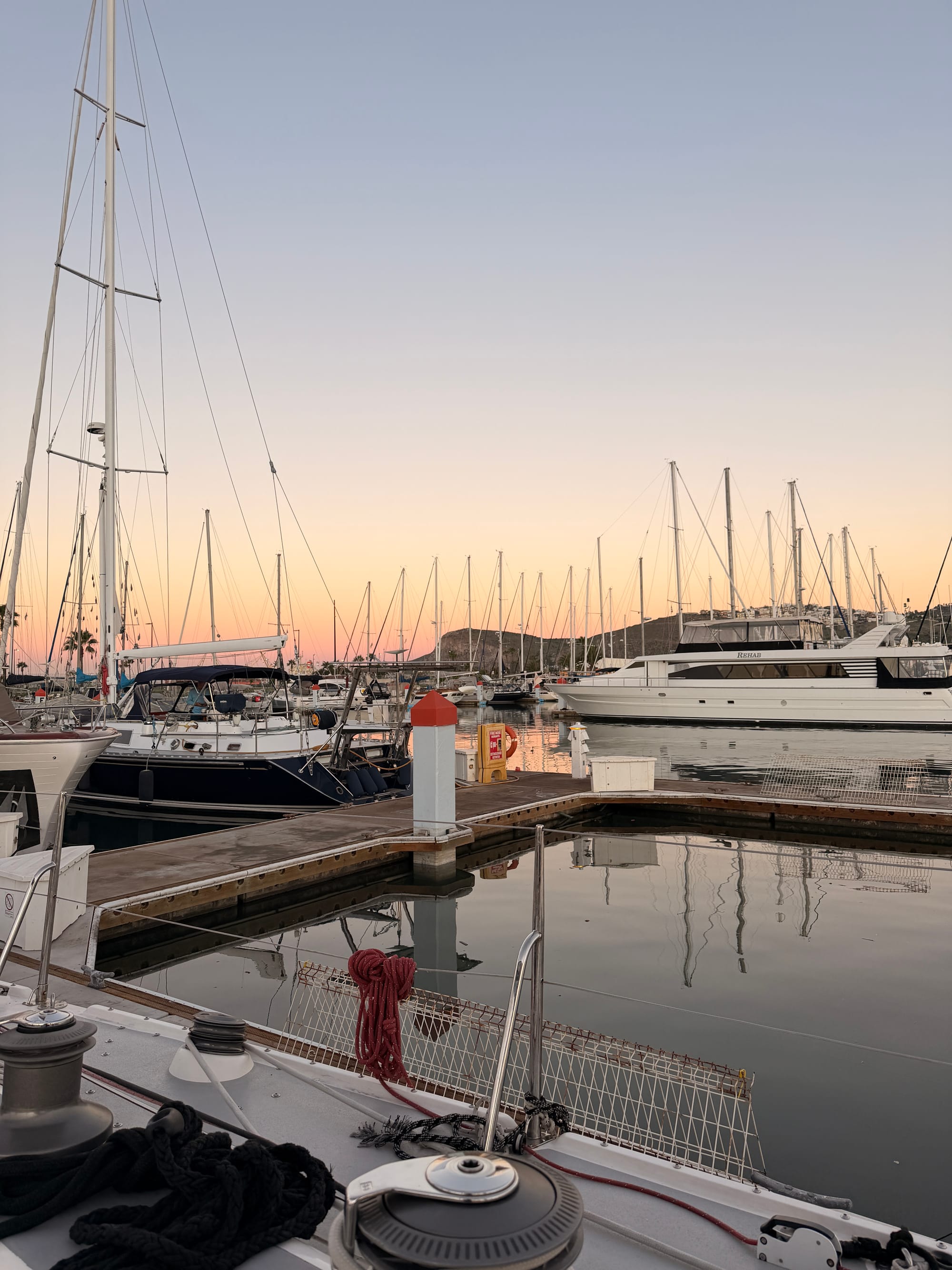
As soon as the possibility arose, the motor was silenced, the headsail unfurled, and our dark triangles trimmed properly to close Ensenada in the setting sun. Sailors who make landfall after a passage frequently talk about the powerful first scents of land. Often this is romantic, as when approaching a small tropical island, you might smell flowers and raw, earthen fecundity. Less discussed might be approaching an island covered in penguin shit or, really, any high density human settlement. I had assumed we would not be gone long enough on this short passage to have the experience, but it was there, significantly more fetid than fecund. Civilization, the world over, does not smell good. And all it takes is a brief departure and return to realize just how rank we are.
What’s tricky is to explain how strangely delightful this wretched sensation was: All of the ups and downs of the passage were a part of an extraordinary whole and, in this way, the entrance to Ensenada was draped in its own pleasure, not the least of which was a marching band, ensconced somewhere on or near the dock, which felt for all the world like it was there just for us. The final toast with comrades at the end of a journey was a welcome capstone.
Sailing as paying crew with a company like 59 North is not necessarily how you get the legitimately precious experiences I managed to horde on this trip. I can find sailing through night skies and bioluminescence on my own, eventually. The same with sailing into the dawn and into the dusk or swimming in the open sea. Most people do. To pay for a trip like this is a serious and committed investment. What we were after was the full range: Safety briefings and scenario practice coupled with systems rundowns prior to departure, the discomfort of the first night, having professionals on board when venturing into bigger seas with real winds, making sail changes in the dark, a team to answer our unending but somehow incomplete barrage of questions and concerns. This isn’t our first rodeo with paying to go on a sail training adventure, but it was by far our best.
At a fundamental level, the boat you’re on matters. Previously, we’d been on a chartered boat where the condition of the vessel was one of a number of limiting factors. This time, we were on a boat that is beyond well-maintained, we were on a boat that is truly loved. We had the good fortune to have the mate on our passage be Adam Browne who is also Bosun for 59 North. In other words, it’s his job, year round, to love this boat as hard as he can. Not everyone who sails with 59 North will have the benefit of Adam aboard, and I’m sure it’s still an incredible experience. For me, right now, at this early stage of interaction with both the company and with Falken, I have trouble imagining Falken without Adam. For that matter, I can sometimes struggle to imagine Adam without Falken.
If the quality of the vessel is fundamental, the staff on board is critical. Adam is not only mythologically intertwined with Falken, he is one of my favorite types of people. He’s a maker, a generalist, a stunningly kind and reasonable human possessed of an insatiable creativity. If I never see him again, I will remain glad at having met him. A man of resonant and honest emotions, he’s also a thinker, and both a delighted and delightful conversationalist, eager to share his own experiences and observations.
The apprentice on board, David Björkqvist, aka “Snacky” was bolstering his own ever-increasing experience and proficiency by sailing with 59 North. He is heroically bright and positive, a deeply frank and forthright man, caring and generous with his knowledge and quick with a quality, off-kilter humor. He reminds me of an old Spalding Gray quote from the monologue Swimming to Cambodia: "Body of Zorro, eyes of Rasputin, heart of Jesus." In truth, though, he may have to work on the snacking if he really wants the Zorro bod.
Our skipper, el jefe, el maestro, Alex Laline, is an only-good-vibes kind of guy with a low-key attitude toward his own extensive experience and expertise. He was quick with a smile and a joke, but there was never a doubt that he was 110% in touch with the boat, with the weather, the navigation, the sail trim, the condition and mood of the crew. Alex provided some of the most simple, patient, clear eyed, and understandable responses to our nagging questions, including some that have resulted in endless prevarication and outright contradiction from other sailors we’ve met in two years of lessons, refitting, and early sailing. His simple and unpretentious depth of expertise and easy manner was both a relief and a revelation. He’s a natural and extremely gifted educator.
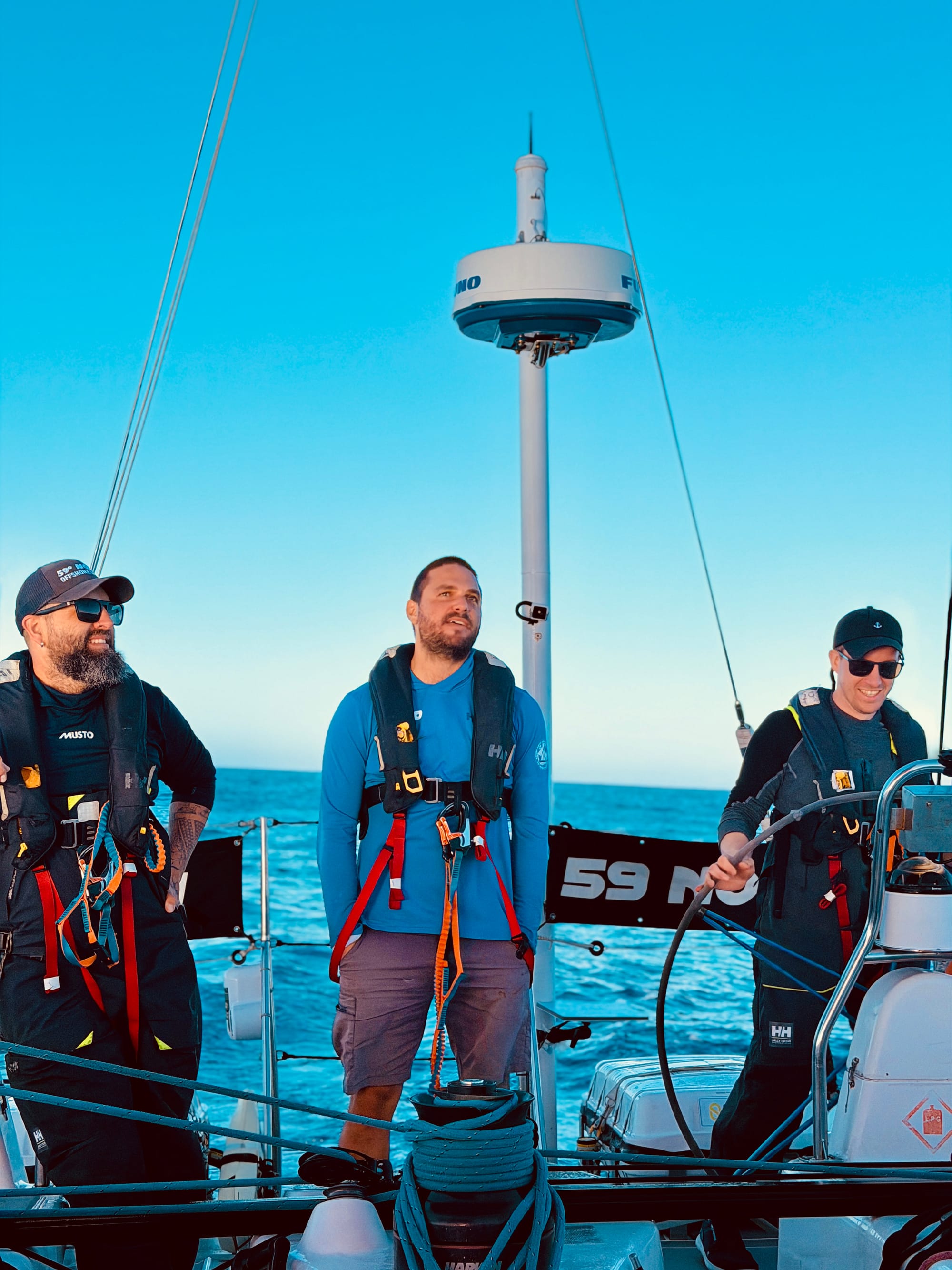
These three managed—and empowered us to manage—an enormous, high-performance sailing vessel in a variety of conditions on the open sea and did it with grace and ever-present smiles while simultaneously and discreetly doing all of their other work: Managing personalities, nursing seasickness, maintaining morale, doling out subtle therapy sessions, keeping schedules, offering casually masterful instruction, cooking excellent meals, minding hydration, medication, proper gear usage, and safety practices. And, you know, making sure no one gets hurt or killed. It simply takes specific and exceptional personalities to do all of this with relentless cheer. What’s more, the general communication and process with the larger 59 North team, both before and after the passage, has been exceptional.
Still, why would I pay thousands of dollars for this when I have my own boat and I often feel barely able to afford the repair and parts it demands? Why might you pay thousands of dollars for this experience?
For me, it’s because the single most important piece of gear on my own boat is me. Spending money on my own skillset, growth, and capability is always going to be my best long-term value. I get that there are famous sailors who are almost entirely self-taught, some of them now teachers themselves. I actually have a high degree of confidence in my ability to develop new skills on my own that might intimidate some folks. But I’ve also slowly realized that if you are able, through circumstance or through raw determination, to put yourself in a position to learn from those who know, there are immense gains to be had. If those knowledgeable people can also be individuals who enjoy and excel at teaching, that’s pure gold.
Even if you’re not like me and feverishly teaching yourself to sail oceans, but you’re somewhat interested in adventure, expedition, the natural world, and less common travel experiences, sailing with 59 North or a similar outfit is something worth considering. But this is the one I can recommend. The money I spent, compared to shelling out similar amounts on other adventures and misadventures, was worth it for the experiences alone. When I add the knowledge gained, the resources amassed, I can start to convince myself it was a bargain. My passage was brief, but also accessible and attainable in terms of locations and schedules.
This entry in the Strange Monkeys project is an abbreviated version of my passage on Falken and, for the sake of brevity, I have refrained from enumerating the things I feel I’ve learned. It was a leap of faith to write the check and it came with trepidation. But now, I’m trying to figure out how long I’m going to have to wait before I can do it again.
With great gratitude to Alex, Adam, David, and Mia at 59 north and to the rest of the crew: Stina, Greg, Heather, Mitch, Seana, Flynn and, of course, Katherine.
Member discussion